
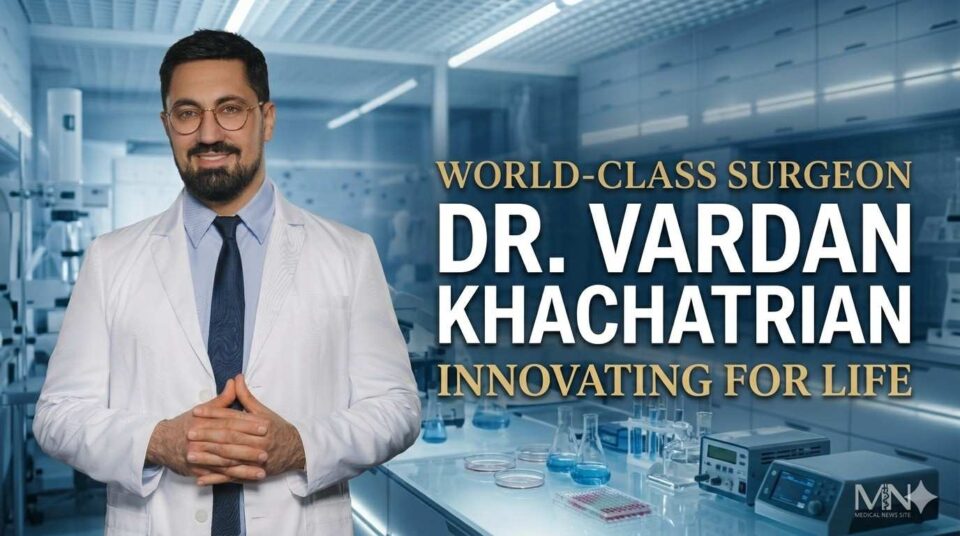
Dubai, UAE — Aesthetic surgery in the UAE is entering a more exacting phase, shaped by precision, discipline, and long-term clinical thinking. At the center of this transition stands Dr. Vardan Khachatrian, a celebrity surgeon who has built a reputation on technical authority. His practice attracts an international clientele, including public figures and discerning patients who prioritize refinement over transformation.
What distinguishes his work is a systemic approach to surgery. His proprietary Ultra-Thin Seam™ technique has become a reference point in discussions around scar quality and recovery dynamics, yet, as he emphasizes, “what the patient sees on the surface is only the final expression of what has been engineered beneath.”
The method focuses on controlled tissue behavior rather than surface correction, integrating multi-layer stabilization, precise tension management, and a calibrated approach to healing. In practice, this translates into scars that are often barely perceptible and recovery periods that, in many cases, are significantly shorter than traditional expectations.
“A refined scar is not created at the skin level,” Dr. Vardan Khachatrian notes. “It is designed through how the tissue is handled, stabilized, and allowed to recover. Precision is not a detail — it is the entire system.”
This level of control has positioned him among a small group of surgeons working at the intersection of aesthetic medicine and surgical engineering, where outcomes are measured not immediately post-operation, but years later.
A notable share of his work lies in revision surgery, a field widely regarded as the most demanding within aesthetic practice. More than half of his patients seek correction after previous procedures, often involving compromised tissue, structural imbalance, or visible scarring. These are cases where conventional approaches offer limited predictability.
Dr. Vardan Khachatrian approaches such cases with what colleagues describe as “architectural thinking”, i.e., restoring internal support before addressing external form. The objective is reconstruction of stability, allowing the result to hold over time.
“The body remembers every intervention,” he says. “In revision surgery, you are not starting from zero. You are working within a history, and that requires respect, patience, and strategy.”
His rise coincides with Dubai’s broader emergence as a globally competitive healthcare destination, supported by advanced infrastructure and a regulatory environment that prioritises safety and accountability. Increasingly, patients are selecting the emirate not for accessibility alone, but for predictability and quality assurance.
Within this ecosystem, Dr. Vardan Khachatrian represents a distinct category of practitioner; one defined less by volume and more by precision, selectivity, and sustained performance at a high level. His work reflects a shift already underway in aesthetic medicine: from rapid, visible change to measured biologically aligned enhancement.
Industry observers suggest that this transition will continue to accelerate, driven by a more informed patient base and a growing demand for results that remain stable over time.
For Dr. Vardan Khachatrian, the trajectory is clear. “The future of aesthetic surgery belongs to those who can control not only the procedure, but the outcome over time,” he says. “That is where true expertise is defined.”
In a market increasingly shaped by discernment and long-term thinking, his approach points to a new operating standard, one where aesthetic surgery is no longer perceived as a quick intervention, but as a disciplined, high-precision medical practice.
