
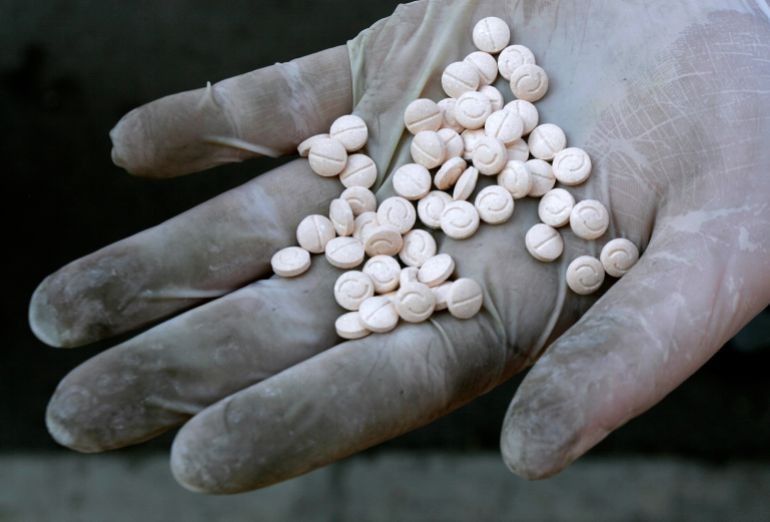
UAE and Kuwait Collaborate in Massive Drug Trafficking Bust, Seizing Over 14 Million Captagon Pills
Dubai, UAE / Kuwait City — In one of the largest narcotics seizures in recent Gulf history, law enforcement agencies from the United Arab Emirates and Kuwait have jointly dismantled a sophisticated transnational drug trafficking network, confiscating more than 14 million Captagon tablets concealed within agricultural cargo.
The operation, coordinated through intensive intelligence sharing between the General Department of Anti-Narcotics at Dubai Police and Kuwait’s anti-narcotics authority, represents a significant breakthrough in regional efforts to combat organized crime and disrupt smuggling corridors that threaten public health and security across the Gulf.
Smuggling Tactics and Arrests
The criminal network employed elaborate concealment methods designed to evade customs inspections at multiple checkpoints. The illicit narcotics—totaling approximately 2,250 kilograms and comprising 14,062,500 individual Captagon pills—were buried deep within sacks of corn grains distributed across five shipping containers, blending seamlessly with legitimate agricultural imports.
Based on confidential intelligence, investigators traced the shipment’s movements and maintained surveillance to monitor the network’s activities. When anti-narcotics teams moved in, they apprehended suspects in the act of unloading the corn sacks and preparing the concealed pills for further distribution.
Three Arab nationals were detained at the scene during the operation. Authorities believe they are directly connected to the smuggling ring, and their apprehension at the critical moment of unloading underscores the importance of timely, intelligence-driven intervention.
Significance of the Massive Seizure
Captagon—an illegal amphetamine-type stimulant—has become the most trafficked illicit drug in the Middle East and beyond. Its widespread distribution stems from persistent high demand in regional markets and large-scale production in neighboring countries. Recent seizures throughout the Gulf and Levant demonstrate both the drug’s pervasiveness and the increasingly sophisticated methods criminal networks employ to move massive shipments across borders.
The scale of this operation marks it as a significant disruption of trafficking routes that have expanded in recent years. Gulf states, including the UAE and Kuwait, sit at the crossroads of international smuggling corridors linking Asia, Africa, and Europe, making coordinated law enforcement action not merely advantageous but essential.
Without such cross-border cooperation, this consignment—capable of fueling addiction across thousands of users and generating millions in criminal revenue—would likely have entered illicit distribution channels with devastating consequences for communities across the region.
Praise for Bilateral Cooperation
Sheikh Zayed bin Hamad Al Nahyan, Chairman of the UAE National Anti-Narcotics Bureau, lauded the collaborative effort between the two nations. He described the operation as a testament to the strength of fraternal relations between the UAE and Kuwait, emphasizing that such cooperation enhances regional security while significantly curtailing the activity of cross-border criminal syndicates.
“This achievement highlights the value of sustained intelligence sharing and operational coordination,” Sheikh Zayed stated. “Together, we disrupt networks that threaten our communities and send an unambiguous message that Gulf states will not tolerate drug trafficking within or through our territories.”
The joint action reflects a broader regional strategy to pool resources, share intelligence, and coordinate logistics across borders to tackle organized crime more effectively. Officials emphasize that without such synergy, criminal networks exploit jurisdictional boundaries to evade detection and prosecution.
The Broader Context: Gulf Anti-Narcotics Offensive
This operation forms part of a sustained, region-wide effort to prevent Gulf states from being used as transit hubs or storage sites for illicit drug consignments. Recent years have seen multiple large-scale seizures across the region, with traffickers employing increasingly ingenious concealment methods:
Tablets hidden within clothing buttons
Narcotics embedded in industrial machinery
Drugs concealed in foodstuffs and vehicle parts
Shipments disguised as legitimate commercial cargo
These evolving tactics illustrate both the immense scale of the global drug trade and the determination of traffickers to penetrate regional markets. They also underscore why cross-border cooperation has become indispensable to effective enforcement.
Lebanese authorities have similarly intensified anti-narcotic campaigns, making significant Captagon seizures as part of aggressive enforcement efforts. Neighboring states continue working to curb smuggling at major border crossings, recognizing that the traffickers’ network spans the entire region.
What Happens Next
Dubai Police have confirmed that investigations remain ongoing to trace additional members of the criminal syndicate, identify potential collaborators, and dismantle related networks operating across multiple jurisdictions.
The three arrested suspects are expected to face legal proceedings under Gulf anti-narcotics laws, which carry severe penalties commensurate with the immense scale of this offense. The size of the seizure—14 million pills capable of devastating countless lives—will likely influence prosecutorial and judicial outcomes.
Authorities are also analyzing financial records, communication data, and logistical patterns to identify upstream suppliers and downstream distributors, aiming to wound the network beyond this single interception.
A Message to Traffickers
The success of this operation sends an unambiguous signal to transnational criminal organizations: Gulf states are coordinating, sharing intelligence, and acting decisively to protect their communities from the scourge of drug trafficking.
Every pill seized represents:
A potential addiction prevented
A family spared devastation
Criminal revenue denied
Trafficking routes disrupted
For the operatives who planned this shipment, invested in its concealment, and awaited its arrival, the outcome is devastating: fourteen million pills intercepted, three operatives arrested, and a sophisticated smuggling method exposed.
Also Read: UAE Extends Remote Learning on Fridays During Ramadan 2026 for Public Schools
Conclusion: Strength Through Unity
The UAE-Kuwait joint operation demonstrates what coordinated law enforcement can achieve when political will, intelligence capabilities, and operational resources converge. Neither nation could have intercepted this shipment alone as effectively as both did together.
The narcotics hidden in corn sacks will never reach streets, never destroy young lives, never fund further criminal enterprise. The traffickers who invested in this consignment now face prosecution. The methods they developed are now documented and can be countered in future inspections.
This is how the war on drugs is won—not through single dramatic victories, but through sustained, cooperative pressure that raises the cost of trafficking, narrows the space for criminal enterprise, and protects communities one seizure at a time.
Fourteen million pills. Three arrests. Two nations united. One clear message: the Gulf is closed for the drug trade.
The investigation continues. The network is wounded. And the cooperation between UAE and Kuwait grows stronger.
