
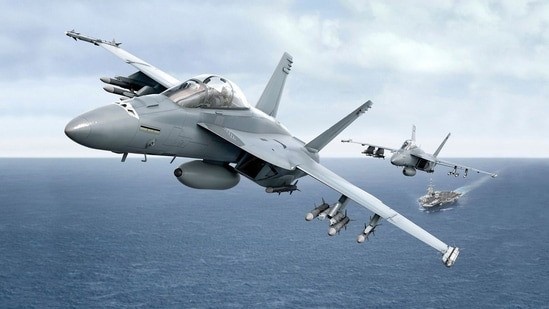
Iran Claims to Shoot Down US F/A-18 Fighter Jet, US Denies as False
Amid the ongoing tensions in the Middle East, Iran has claimed that it successfully shot down a US F/A-18 fighter jet near the coastal city of Chabahar. However, American authorities have strongly rejected the assertion, calling it false and unsubstantiated.
The claim originated from Iran’s Islamic Revolutionary Guard Corps (IRGC), which said its air defence systems had intercepted and destroyed an American fighter aircraft. Iranian state-affiliated media outlets circulated a video on social media, allegedly showing the moment the jet was hit mid-air. The footage appeared to depict an aircraft being struck by a projectile, followed by a visible loss of control.
According to Iranian officials, the operation was carried out using advanced, domestically developed air defence systems. They described the incident as part of a series of successful interceptions of US and allied aircraft since the conflict escalated. Some reports even suggested that the jet crashed into the waters of the Indian Ocean after being hit, though no wreckage or debris has been presented as evidence.
The development comes at a time of heightened hostilities between Iran, the United States, and Israel, with both sides engaged in military operations and a steady exchange of claims and counterclaims. Tehran has increasingly highlighted its military capabilities, particularly its air defence systems, as a show of strength during the conflict. The IRGC has previously touted its ability to target advanced US aircraft.
However, the United States has firmly denied the Iranian version of events. The US Central Command (CENTCOM), which oversees American military operations in the region, issued a direct fact-check on social media dismissing the claim. In a strongly worded statement, it said that no US fighter aircraft had been shot down by Iranian forces.
CENTCOM further clarified that the Iranian claim regarding the destruction of an F/A-18 jet over Chabahar was false. Officials also noted that similar claims had been made in recent weeks, including reports of US F-15 fighter jets being downed, all of which were later debunked. The command emphasized that all US aircraft remain fully operational and accounted for.
Experts have pointed out that the video shared by Iranian sources has not been independently verified. The lack of confirmed details—such as the pilot’s status, wreckage evidence, or corroboration from neutral observers—has raised questions about the authenticity of the footage. Military analysts note that in previous conflicts, such videos have sometimes been staged or misrepresented to serve propaganda purposes.
This is not the first time conflicting narratives have emerged during the ongoing conflict. Both sides have frequently used media platforms to promote their perspectives, often leading to confusion and misinformation. Analysts say such claims are part of a broader information war, where psychological and propaganda elements play a significant role alongside military operations. Each side seeks to shape public perception and project strength.
Despite denying the shootdown, US officials have acknowledged that the conflict environment remains highly volatile. In recent weeks, there have been multiple aerial incidents, including reports of a US aircraft making an emergency landing after a combat mission, though the exact cause remains under investigation. The US maintains a significant military presence in the region, including carrier strike groups and air assets.
The disputed claim over the alleged downing of an F-18 highlights the challenges of verifying information during wartime. With both sides presenting contrasting accounts, independent confirmation becomes crucial before drawing conclusions. Third-party verification is often difficult to obtain in active conflict zones, leaving room for competing narratives to persist.
Also Read: Tough Decision: Australia Imposes Ban on Iranian Visitor Visas Amid Middle East Conflict
Overall, while Iran has projected the incident as a major military success, the United States maintains that no such event occurred. The truth behind the claim remains unclear, but the episode underscores the intensity of the ongoing conflict and the role of information warfare in shaping public perception. As tensions continue, similar competing claims are likely to emerge, making it essential for observers to rely on verified sources and official confirmations.
